I've spent 28 years in institutional finance in Japan, evaluating what deserves capital.
And I've spent the last several decades inside Japan's children's homes with YouMeWe NPO, watching what happens when capital — of every kind — finally arrives.
Let me show you the two charts that changed how I think about both.
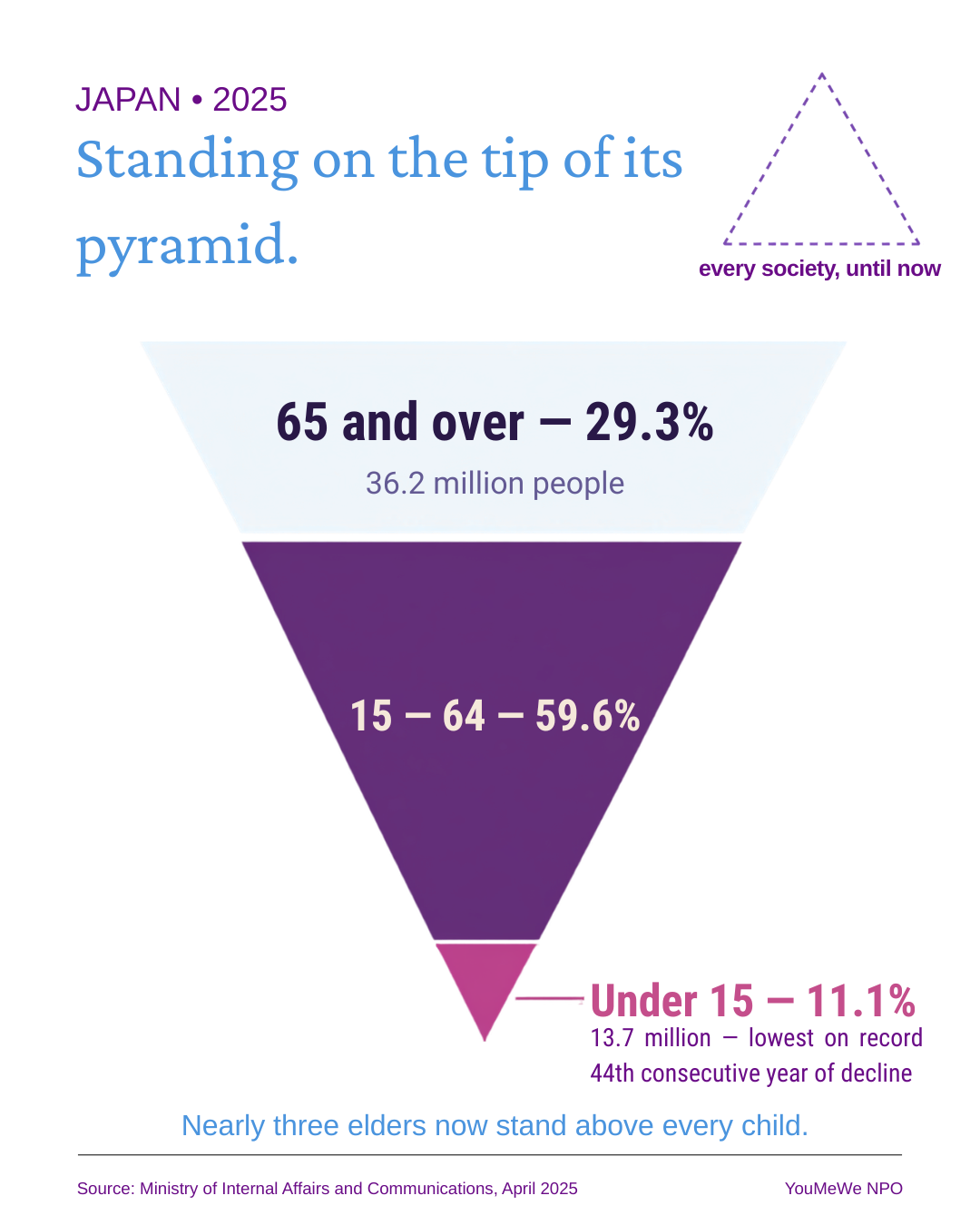
The first chart is Japan's population pyramid — and it's upside down.
Japan's upside down triangle
For all of history, societies stood on a broad base of children supporting a narrow peak of elders. Japan has inverted: 29.3% of the population is now over 65. Just 11.1% is under 15 — 13.7 million children, the lowest number ever recorded, falling for 44 consecutive years. Nearly three elders now stand above every child.
The entire weight of Japan's future rests on the smallest generation of young shoulders this nation has ever raised.
The second chart about the circle is the one almost nobody looks at.
Roughly 40,000 of those children are growing up in alternative care — the great majority in institutions, not families. At eighteen, they age out. No family network. No safety net. Often, no one who stays.
Most people call these children marginalized. Vulnerable. At-risk.
I've stopped using those words, because after years alongside these young people, I can tell you they're inaccurate.
These children are not marginalized. They are maximizeable.
In finance, we hunt for exactly this profile: maximum unrealized capacity, minimum prior investment. Give these young people digital skills, mentorship, financial literacy, and one adult who doesn't leave — and they don't catch up. They take off. I've watched YouMeWe alumni become designers, technologists, professionals. Nobody rescued them. Someone invested in them.
In a country with the developed world's narrowest base of young people, a child whose potential goes unrealized isn't a private tragedy. It's a national loss Japan cannot afford. And the reverse is also true: there is no higher-return investment available in Japan's future than the children Japan has invested in least.
Japanese communities always knew what to do when the load was too heavy for a few: form a circle.
For centuries, the tanomoshi-kō (頼母子講) pooled many small contributions so each member, in turn, could seize their moment. Japanese immigrants carried the tanomoshi across the Pacific, and it funded the first shops, farms, and firms of families who arrived with nothing but each other. Some of you reading this are here because a circle once held for your family.
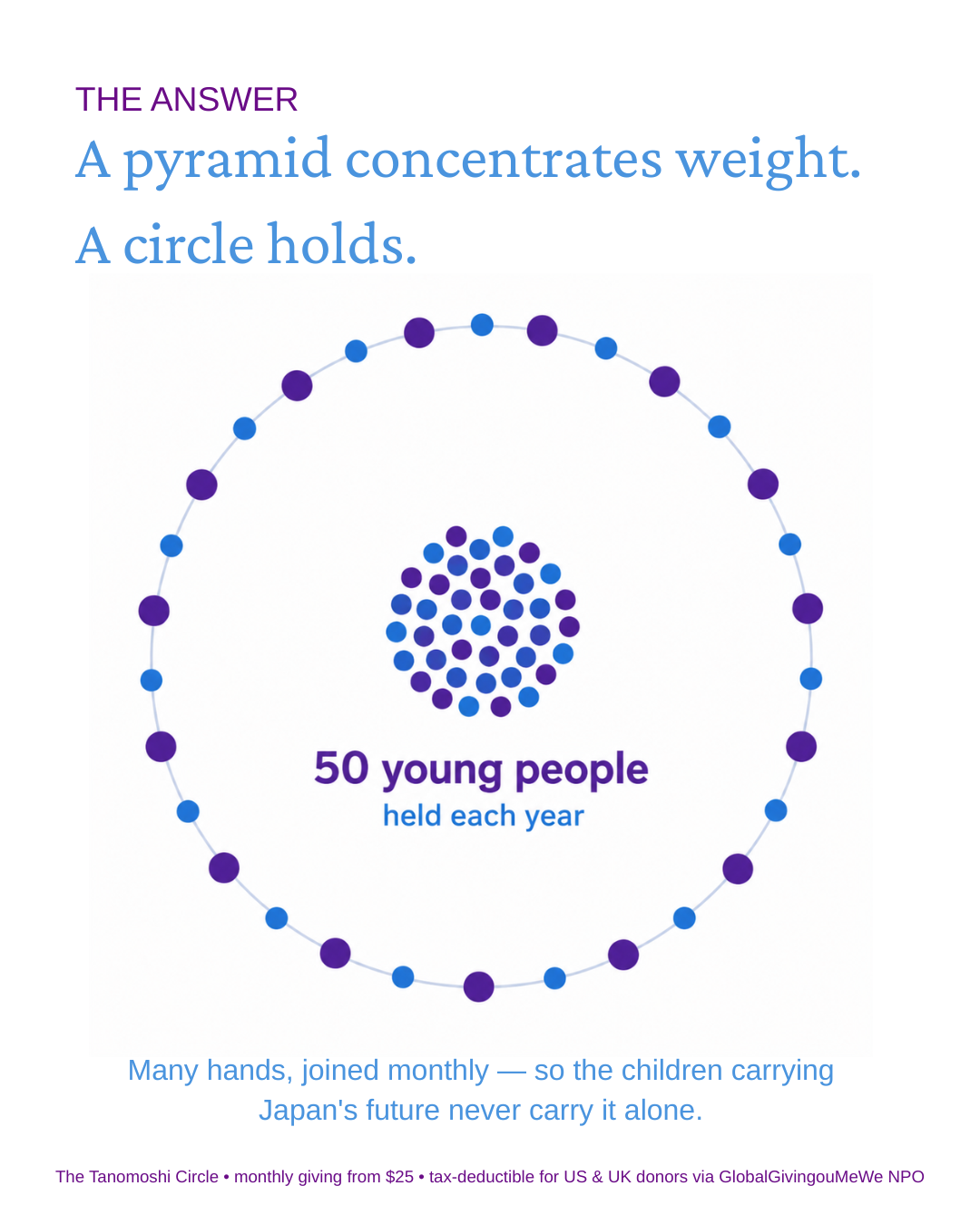
A pyramid concentrates weight downward. A circle distributes it — and holds.
That's why we're launching the Tanomoshi Circle: a monthly giving community that puts many hands under the 50 young people YouMeWe supports each year — through their education, their skills, and the critical transition out of care at eighteen.
Here's my ask.
Join the circle. Monthly membership starts at $25 — tax-deductible for U.S. and U.K. donors through GlobalGiving, our giving portal.
https://www.globalgiving.org/pro.../the-tanomoshi-circle/...
And if you can't join today, do one of the tanomoshi's oldest jobs: widen the circle. Share this article with one person whose family story includes a circle that held.
Japan is standing on the tip of its pyramid. The answer was in our hands the whole time — all of them, joined.
Michael Perry Clemons is the founder of YouMeWe NPO, supporting children in institutional care across Japan,Philippines and Brazil. — Which words do you think we should retire when we talk about young people in care? I'd genuinely like to hear your view in the comments.